
What you will learn
- Single model dependency creates operational risk - When ChatGPT went down for 12 hours in June 2025, thousands of businesses lost access to critical AI capabilities with no backup plan
- Model routing is becoming core architecture, not a niche optimization for a handful of labs
- Routing slashes inference costs dramatically - Task-specific model routing can reduce inference costs by up to 85% by sending simple queries to smaller models instead of expensive frontier ones
- TCO reality demands multi-model thinking - Most enterprise budgets underestimate AI total cost of ownership, and a large share of organizations report AI costs putting pressure on gross margins
Also in the Claude cost series:
- Claude.ai web app costs - chat interface (Pro/Max users)
- Claude Code subscription costs - terminal (Max 20x users)
- Claude API costs - pay-per-token developers
- LLM prompt caching strategies - caching design
Each tackles a different surface. Read the one that matches how you actually use Claude.
When ChatGPT went dark for over 12 hours on June 10, 2025, businesses worldwide sat staring at error messages. No fallback. No backup. Just nothing.
The cost of unplanned downtime is brutal for any business running AI in production. Yet most teams still build their AI systems around a single model from a single provider. Even as AI adoption reaches near-universal levels across organizations and enterprises pour tens of billions into generative AI annually.
That’s a liability. A crisis waiting to happen.
The single point of failure problem
OpenAI’s track record tells the story. Their uptime metrics hover around 99.3%, which sounds reassuring until you do the math. That’s roughly 5 hours of downtime per month. December 2024 brought a roughly four-hour outage when a new telemetry service overwhelmed OpenAI’s Kubernetes control plane and broke service discovery.
Five notable disruptions hit by mid-2025.
Every company depending solely on one OpenAI model felt every minute of those outages. Customer service stopped. Content generation froze. Internal tools failed. Nothing to do but wait and hope.
A food manufacturer recovered $0.5 million per week in lost productivity once better AI reliability measures were in place. SLA penalties, lost revenue, and burned customer trust add up fast when your only model goes dark.
This pattern keeps repeating, and I find it frustrating. We treat AI like it’s fundamentally different from other critical infrastructure. We wouldn’t run production databases without replication. We wouldn’t deploy applications without load balancing. But somehow we’re comfortable putting all our AI eggs in one basket.
The AI market makes this worse. Cloud hyperscalers command roughly 63% combined share of AI cloud infrastructure, and enterprises are consolidating their spending through fewer vendors. That concentration of dependency is exactly why 89% of organizations now use a multi-cloud strategy, with many even moving workloads back on-premises to escape vendor dependencies altogether.
How model diversity works
A multi-model strategy isn’t about using every available model for everything. It’s about intelligent redundancy. Mind you, ‘intelligent’ does a lot of heavy lifting there. Model routing is now the core architectural pattern for serious AI deployments. Even state-of-the-art providers deliver their products as “mixtures of experts.” Collections of task-specialized models behind a unified front-end. Serious AI deployments increasingly route across several task-specialized models rather than leaning on one.
This part aged fast in the vendors’ own favor. As of mid-2026, the big developer toolchains ship multi-vendor by default: GitHub Copilot’s supported models span OpenAI, Anthropic, and Google in one product, and Microsoft 365 Copilot is no longer OpenAI-only. The companies that sell you a single model now route across several themselves. That tells you where production is headed.

Start with the no-brainer: primary and secondary models with automatic failover. Your routing layer sends requests to your preferred model first. When that model returns errors, hits rate limits, or times out, the system straightaway routes to your backup. No manual intervention. No downtime for users.
Google Cloud’s reliability architecture guidance pushes the circuit breaker pattern for AI systems. When error rates or latency exceed thresholds, automatically switch to simpler models or cached data. This prevents cascade failures where one struggling model brings down your entire application.
Then layer in task-based routing. Simple questions go to faster, cheaper models. Complex reasoning tasks hit your most capable models. Task-specific routing can cut inference costs by up to 85% - simple queries go to smaller models, and expensive frontier models only handle tasks that really need them.
The within-Claude version of this is just as stark. I asked Haiku 4.5, Sonnet 4.6, and Opus 4.7 to write the same 50-word paragraph explaining TCP versus UDP. The Opus answer was no better than the Haiku answer for that task, but the cost gap was 5.5x:
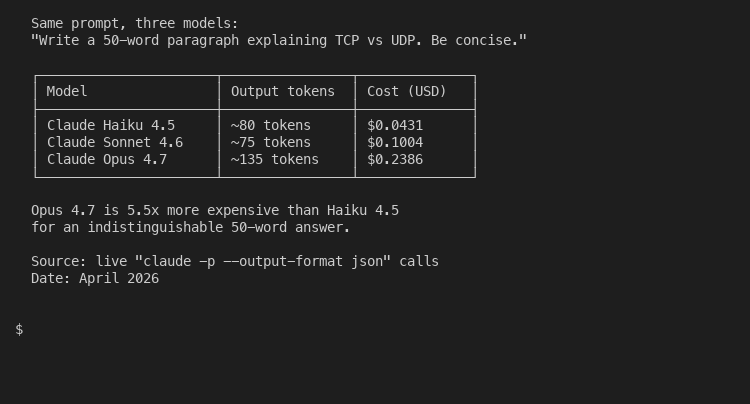
Routing simple writing tasks to Haiku and reserving Opus for hard reasoning is not a hypothetical save - it is a 5x lever on the exact same workload. The Claude.ai web-app side of this decision walks through when each model earns its keep on chat workflows.
The tiered cascade approach takes this further. A simple question gets answered by a small model. Only if quality checks fail does it escalate to a larger, more expensive model. Think tiers: tiny local model, small cloud model, medium, then large. One routing demonstration showed a marketing team that slashed prompt costs by over 99% with intelligent routing through Arcee Conductor.
There’s also the plan-and-execute pattern: a capable model creates a strategy that cheaper models then execute. That cuts costs sharply compared to frontier-only approaches. Pair two smaller models and they can match the accuracy of one massive model - at a fraction of the price.
Want a second pair of eyes on your situation? Blue Sheen is built for this.
Building resilience into your architecture
Is a backup model enough? No. Real resilience requires more than just backup models. You need infrastructure to manage them.
LLM gateways sit between your application and model providers. They handle all the complexity of routing, failover, and load balancing. Platforms like LiteLLM and Portkey provide production-grade orchestration that most teams shouldn’t try to build themselves.
These gateways do several things well. They normalize API differences across providers so your code doesn’t need to know whether it’s talking to OpenAI, Anthropic, or Google. This is the kind of reliable agent architecture that separates production systems from prototypes. Semantic caching cuts redundant calls. Observability data across all your models lands in one place.
Production AI today is not single models but what Matei Zaharia at Databricks calls compound AI systems. Orchestrations of foundation models, fine-tuned adapters, retrieval systems, guardrails, routing logic, and feedback mechanisms. Each component has its own lifecycle and optimization opportunities. Your gateway is the stabilizing layer that absorbs model volatility as providers shift pricing, capabilities, and availability. The gateway keeps your model choice portable. Do the same for company knowledge: feed every model in the rotation one owned AI context layer, so swapping models never means re-teaching the company.
The routing strategies get complex fast. Latency-based routing constantly measures which provider is faster right now and adjusts traffic accordingly. Models can be selected based on where they run: edge, on-premises, or public cloud. Latency and cost impact drive the choice. Priority-based routing maintains a preference order but degrades gracefully when preferred models aren’t available.
Circuit breakers prevent partial outages from becoming total failures. When one model starts showing elevated error rates, the circuit breaker temporarily stops sending it traffic until health checks pass again. Your users never see the problem.
The agentic AI wave makes this architecture even more pressing. A large share of agentic AI projects will stall or get cancelled as costs and complexity climb. The agentic AI market is projected to grow roughly 6-7x over the next several years. When agents are making autonomous decisions across your business, having reliable multi-model routing underneath them isn’t optional. It’s the foundation everything else depends on.
The cost equation you’re probably ignoring
Everyone worries that running multiple models costs more. Sometimes it does. Turns out, it often doesn’t. The math has gotten much clearer.
85% of enterprise budgets miss AI cost forecasts by more than 10%. That gap is where AI projects go to die. Enterprise generative AI spending keeps climbing fast, and 84% of organizations report that AI costs are putting pressure on gross margins.
Multi-model routing directly addresses this. Diverting tasks to cost-efficient models is where the real savings come from. Your expensive frontier model calls drop dramatically when you route straightforward tasks to smaller, cheaper models. The price gap is staggering: frontier models can cost 60x more per token than comparable open-source alternatives that run the same tasks. Sixty times. Not a typo.
The real, painful cost is downtime. When your single model goes down, you’re losing revenue, violating SLAs, and burning customer trust. How does that compare to the infrastructure cost of running backup models?
Load balancing across providers gives you negotiating power too. You’re not locked into one vendor’s pricing. When costs change or performance degrades, you can shift traffic to alternatives. This flexibility helps organizations maintain control as the AI market evolves. Especially since most organizations are still piloting AI agents rather than running them in production. Too many of those pilots get abandoned after cost overruns.
Mind you, there’s also the hidden cost of poor quality. When a model is overloaded or degraded, response quality suffers even if it’s technically available. Users get worse results. Cost optimization is now a first-class architectural concern, similar to how cloud cost optimization became essential in the microservices era. Proper load balancing ensures your models always perform within their optimal ranges.
What to do
Start small. Pick one critical use case. Set up primary and secondary models with basic failover. Then test that the failover works when you need it. Too many teams discover their backup strategy is broken during an actual outage.
Monitor everything. You can’t optimize what you don’t measure. Track latency, error rates, costs, and quality across all your models. Distributed tracing helps you understand exactly what’s happening as requests flow through your system.
Build your abstractions right. Your application code shouldn’t know or care which specific model is processing a request. That flexibility is what lets you adapt as models improve, pricing changes, and new providers emerge.
Think about degradation paths. When your best models fail, what’s your acceptable fallback? Maybe it’s a smaller model that gives decent but not great results. Maybe it’s cached responses for common questions. Maybe it’s a graceful error message. Whatever it is, design for it deliberately rather than discovering what happens when you’re already in crisis mode.
I think the most overlooked part of all this is that architecture decisions compound over time. Most organizations never get AI to deliver real results, usually because of weak data foundations, inadequate governance, and poor integration. RAND notes that by some estimates, more than 80% of AI projects fail. That’s twice the rate of IT projects without AI. Will better models fix that? No. Your architecture decisions, including multi-model routing, are what separate the companies that scale from the ones stuck in pilot mode.
Multi-model routing is an architectural evolution, not a trend. Cost efficiency isn’t about picking the cheapest model. It’s about picking the right model for each step of the workflow. The hard truth? Resilience matters more than performance. The fanciest model is worthless when it goes down and your entire operation stops with it.