
Quick answers
Why do fixed-scope AI contracts fail? They lock you into assumptions about data quality and workflows that fall apart the moment real work begins.
What works instead? Agile engagement models with short discovery phases, outcome-based pricing, and built-in pivots succeed at roughly 3x the rate of waterfall approaches.
Where should the money actually go? The 10-20-70 rule says 70% of effort belongs in people and processes, 20% in technology, and only 10% in algorithms.
The consultant hands you a thick document. Statement of Work. Fixed scope, fixed price, fixed timeline. Looks professional. Feels safe.
You sign it. Six months later, the project is behind schedule, over budget, and solving the wrong problem. That outcome was baked in from the moment you agreed to define AI implementation requirements up front.
RAND Corporation noted that by some estimates, more than 80% of AI projects fail - at roughly twice the rate of IT projects without AI. The root causes behind why AI projects fail often trace back to the engagement structure itself. The typical response to these numbers? Write even more detailed requirements. Bigger contracts. Tighter scope.
Wrong direction.
The certainty trap
What actually happens when you lock down AI project scope before you start: you base estimates on assumptions about your data quality, your team’s readiness, and your workflows that turn out to be fiction. This is what Daniel Kahneman’s planning fallacy looks like in practice.
Your consultant says it will take three months to build a document classification system. Sounds reasonable. Then you discover your documents exist in 47 different formats, half your team doesn’t trust AI output, and your approval process has 12 hidden steps nobody ever wrote down.
The fixed-scope contract now forces everyone into a corner. The consultant rushes to deliver what the contract says instead of what you actually need. You withhold payment because what you received doesn’t solve your problem. Both sides hire lawyers. The whole thing becomes a nightmare. Nobody wins.
According to the Standish Group’s analysis of agile versus waterfall success rates, agile projects succeed 42% of the time while waterfall hits only 13%. When you start with an AI project that already carries a dismal baseline failure rate, adding waterfall methodology on top is asking for trouble.
What makes AI different from other projects
AI implementation isn’t like installing software. You’re not deploying a known solution to an understood problem. You’re finding out whether a solution exists while simultaneously figuring out what problem you’re actually solving.
Actually, that overstates it a bit. Some parts of AI implementation are routine engineering. The problem is you cannot tell which parts until you are knee-deep in real data.
Take a client who wanted to automate customer support. Straightforward enough on paper. Week one revealed their support tickets were so poorly categorized that training data was basically rubbish. Week two showed agents were already copy-pasting from a knowledge base, so automation would barely move the needle. Week three uncovered that the real issue was a confusing product UI generating unnecessary support volume in the first place.
A fixed-scope AI consulting engagement would have built the wrong thing beautifully. An agile approach let us pivot when we learned the truth. That’s probably the clearest example I’ve seen of why the structure of the engagement matters as much as the technical work itself.
I found research on change management for AI revealing here. The data suggests that change management investment should match or exceed the technology spend itself. The 10-20-70 rule reinforces this - the lion’s share of AI adoption effort should go to people and processes, with far less going to technology, and only a sliver to algorithms themselves. That ratio only makes sense if you expect to learn and adapt constantly, not if you think you can spec everything in advance.
How agile consulting actually works

Stop buying fixed outputs. Start buying outcomes with flexible paths to get there.
Instead of a 40-page scope document, you define success metrics. Reduce support ticket volume 30%. Increase approval speed 50%. Cut document processing time 40%. Doesn’t specify how. Specifies results.
Is this riskier than fixed scope? No. Fixed scope just hides the risk until it is too late to do anything about it.
Your consultant proposes a short initial phase - discovery, assessment, proof of concept, whatever you want to call it. Fixed length, typically two to four weeks. Real work with your real data. No slide decks. Actual code, actual results, actual learning.
This phase answers the critical questions. Can AI help here? What’s blocking us? What will it cost to scale? Where’s the real value? You learn whether this AI consulting engagement model fits your situation before committing serious money.
Then you structure ongoing work in short cycles. Two-week sprints work well. Jeff Sutherland designed Scrum around exactly this principle: short iterations, constant feedback, freedom to change direction. Each cycle delivers working software you can test, generates new learning, and gives you a decision point: continue, pivot, or stop. Compare that to finding out six months in that the whole approach was wrong from day one.
Underneath the diagram the work just looks like dated files. Each SOW runs in short billing periods and every loop leaves a meeting note, so the cadence shows up in the folder itself. The wider system those folders sit inside, with Claude doing most of the typing between the loops, is a separate walkthrough.
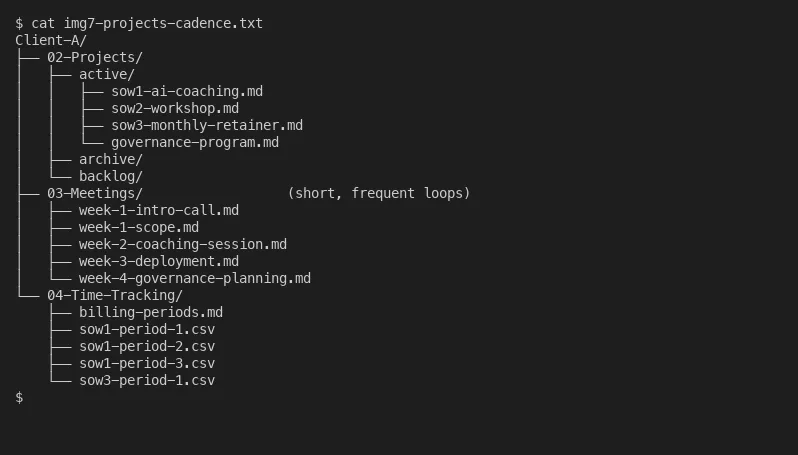
One client’s project and billing folders. The work moves in short periods and frequent notes, not one big drop at the end.
Pricing that actually aligns with results
Value-based pricing sounds obvious until you try to make it happen. You identify measurable business impact. Processing loan applications faster saves money - you can calculate how much. Improving customer matching increases conversion - you can measure it. Reducing errors prevents rework - you know the cost.
Structure fees as a percentage of that value. Typical range is 10-40% of first-year impact. If you save half a million, the consultant gets between 50K and 200K depending on complexity and risk.
Research on AI consulting pricing models argues for a shift toward pricing tied to outcomes rather than hours worked. As the vast majority of companies plan to increase AI investment over the next three years, they’re demanding performance-based pricing and ROI-tied deliverables. This shift matters because hourly billing creates perverse incentives - the consultant makes more money when things take longer. Think about that for a second. Your consultant literally profits from your project going slowly.
Value pricing flips this. Faster success means better margins for the consultant. Your interests align. Simple.
For initial phases, use fixed fees with clear outputs. Proof of concept costs 25K, delivers a working prototype with 100 test documents, takes four weeks. Clear. Low risk for both sides.
Once you prove value, shift to performance-based arrangements. Monthly retainer plus bonuses for hitting targets. Or pure percentage of measured savings. Or hybrid models that share risk in ways that feel fair to both parties.
If this is the work you’re trying to do, we do it as a service.
Making the case to leadership
Your CFO will hate this at first. No fixed price means no certain budget. How do we plan? Fair question.
The argument that actually works: traditional fixed-scope AI projects fail most of the time. MIT’s 2025 study of enterprise AI found only about 5% of generative AI pilots ever produce measurable returns. The rest stall. You budget 500K, spend it all, get nothing. Actual cost is 500K. Actual value is zero. Return on investment: negative 100%.
With agile engagements, you test for 25K. If it works, you invest more. If it doesn’t, you stop. Your maximum loss is 25K. Expected value is higher because you kill bad projects early and double down on good ones. I think most finance teams, once they see it pitched this way, come around fairly quickly.
One survey of data executives found 91.9% blame cultural and organizational obstacles for stalled AI, against just 8.1% who point at the technology itself. Leadership engagement drives the outcome far more than tooling does. It matters even more in agile approaches because leadership needs to make rapid decisions based on what the team is learning.
Frame it as risk management, not uncertainty tolerance. You’re reducing risk by learning faster, not increasing it by avoiding firm commitments.
Procurement will push back too. They need vendor contracts that check boxes. Help them understand that checking boxes on AI projects is exactly what creates failure. The thing is, compliance theater doesn’t reduce risk when the project delivers nothing useful.
Work with them to create outcome-focused contract language. Define success criteria. Set review gates. Specify decision rights. Give them the governance they need without locking in technical details nobody can possibly know yet.
What to do before you sign the next contract
Three questions worth asking before you commit to another fixed-scope AI consulting arrangement.
Can you actually define requirements before touching real data? If yes, you probably don’t need AI - you need software. AI projects carry inherent uncertainty that fixed scope only pretends away.
Are you prepared to learn and adapt based on what you discover? If not, you’re not ready for AI regardless of the contract structure. Save your money.
Do your incentives align with the consultant’s? If they get paid the same whether you succeed or fail, expect failure.
The best AI consulting engagement model treats implementation like the discovery process it actually is. Short cycles. Real learning. Shared risk. Aligned incentives.
This doesn’t mean chaos. It means structure designed for learning rather than pretending certainty exists when it doesn’t. Your project still has budgets, timelines, and accountability. They’re just based on reality instead of fiction.
Fixed scope might feel safer. But safety that guarantees failure is expensive. Especially when the alternative works three times as often.